Indian Developers Will Finally Have Their Own Reality Show

Code Kitchen: When Software Engineering Becomes Reality Television
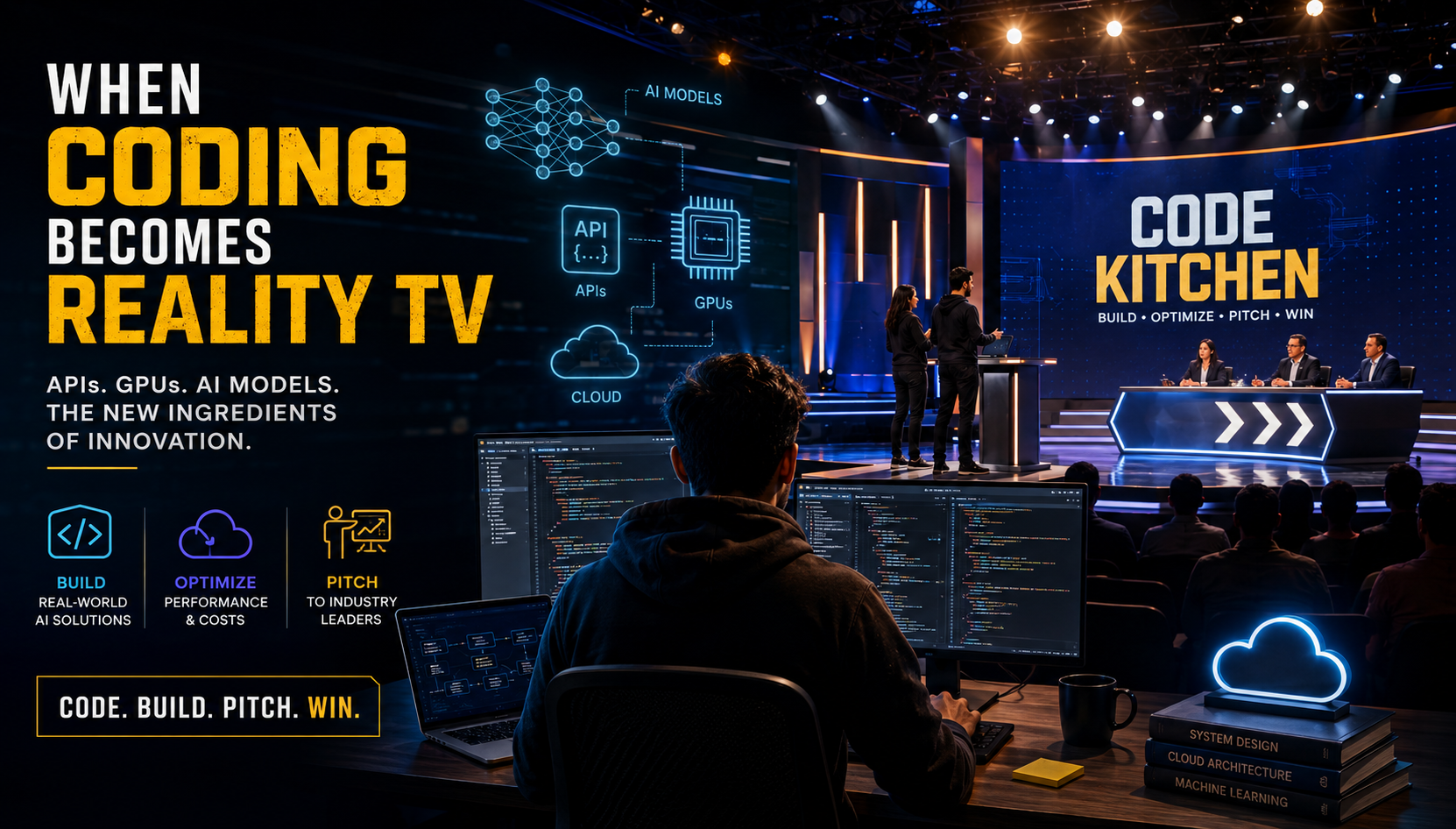
Imagine MasterChef, except the ingredients are APIs, GPUs, and AI models instead of spices. Add the high-stakes product pitches of Shark Tank, where every architectural decision, cost estimate, and scaling strategy is scrutinised before industry leaders.
Key Takeaways
- India is launching its first coding reality show, Code Kitchen, which aims to showcase software engineering as entertainment.
- The show blends elements from cooking competitions and investment pitches, focusing on the creative and strategic aspects of coding.
For years, India has celebrated founders, startup pitches, singers, dancers, comedians, and chefs on television. Yet the people quietly building the software that powers almost every part of modern life have largely remained invisible.
That is finally changing. India is getting its first coding reality show.
Introducing Code Kitchen, an AIM Originals production, presented by Google Cloud. Unlike a regular hackathon or coding competition, Code Kitchen is trying to answer a bigger question: what happens when software engineering becomes entertainment?
Imagine MasterChef, except the ingredients are APIs, GPUs, and AI models instead of spices. Add the high-stakes product pitches of Shark Tank, where every architectural decision, cost estimate, and scaling strategy is scrutinised before industry leaders.
At first glance, the idea sounds unusual. Coding has never exactly been considered binge-worthy television. Most developers spend their days staring at terminals, debugging code, reading documentation, and arguing over architecture diagrams. None of that screams prime-time viewing.
But then again, cooking did not either.
Before MasterChef, professional kitchens were hidden behind restaurant doors. Today millions watch chefs plate food under impossible deadlines. Shark Tank made term sheets and cap tables for household conversations. Formula 1 found an entirely new audience once people saw the stories behind the race.
Software engineering may be next.
That timing is hardly accidental.
The Best Coders, the Masters
AI, or vibe coding, has transformed software development faster than anyone expected. Developers today are no longer judged solely on how quickly they can write code. AI can already generate functions, documentation, and boilerplate applications in seconds. The focus now has shifted toward understanding problems, designing systems, evaluating trade-offs, and shipping products people actually want.
That is precisely where Code Kitchen wants to focus.
Instead of solving algorithm puzzles or climbing leaderboard rankings, participants will build applications around real-world business problems using AI and cloud technologies. They will design, collaborate, defend architectural decisions, optimise costs, and pitch products before industry leaders.
In other words, they will do what engineering teams actually do every day.
The competition starts long before the cameras begin rolling.
How does it work?
Developers from across the country enter through nationwide auditions. Rather than asking candidates to solve coding questions in a few hours, the process begins with a concept note, followed by access to a Google Cloud sandbox where shortlisted participants build their ideas.
The strongest developers eventually make it to the studio, where only 20 participants—forming 10 teams—remain.
- Open exclusively to working professionals across India.
- Begin by registering and submitting a concept note outlining your idea.
- Shortlisted participants receive access to a Google Cloud sandbox to build their solution.
- Build within 7 days without disrupting your day job, then submit your code along with a video screencast.
- The strongest participants are shortlisted and paired into 10 teams of two each for the studio rounds.
- The selected teams compete across 8 episodes, solving real-world AI and cloud challenges.
- Winners take home a share of the ₹10 lakh prize pool, the Season Best Trophy, national recognition, mentorship from industry experts, and exposure to leading technology companies.
From there, the pressure changes completely.
Every episode revolves around a fresh industry-inspired challenge. Teams receive a problem statement, build an application under time constraints, leverage certain features provided as prominent ingredients to the build, optimise both performance and economics, undergo technical reviews from mentors, and finally present their product in a Shark Tank-style pitch before a panel of judges.
It deliberately mirrors the rhythm of modern product development:
- You receive a vague business requirement.
- You figure out the architecture.
- You build.
- Someone tells you your costs are too high.
- Another reviewer questions your design choices.
- Then comes the presentation where everyone suddenly forgets how difficult the engineering actually was.
One particularly interesting round asks a question every engineering leader eventually faces:
“How much value does it actually deliver?”
Instead of rewarding the most complicated architecture, judges evaluate efficiency—cost per inference, accurate usage of features provided as ingredients, return on investment, scalability, and whether the solution actually makes business sense.
For decades, developers have carried the stereotype of being brilliant builders who dislike presentations. Whether fair or not, modern engineering increasingly demands exactly the opposite. Today’s technical leaders spend almost as much time explaining systems as building them.
- Engineers pitch products to customers.
- Architects explain trade-offs to business teams.
- Developers convince investors, founders, or clients why one approach is better than another.
Code Kitchen bakes those skills directly into the competition.
Participants are expected not only to build working software but also to explain why they built it that way. That combination of engineering depth and storytelling is perhaps what separates the show from traditional hackathons.
Hackathons often reward speed. Reality television rewards narratives.
Code Kitchen attempts to merge both.
Suman K
Suman is a Product Manager and Growth Specialist with over 6 years of experience driving product strategy, growth experiments, and user-centric execution across EdTech, BFSI, and AI ecosystems. Currently leading digital product initiatives at AIM (Analytics India Magazine), Suman specializes in taking products from zero-to-one and executing high-impact product turnarounds—notably scaling underperforming postgraduate programs by 15x through data-driven discovery and funnel optimization. Suman combines practical enterprise experience from organizations like Great Learning and HDFC Bank with deep insights into modern AI product stacks, GTM strategies, and ecosystem building.