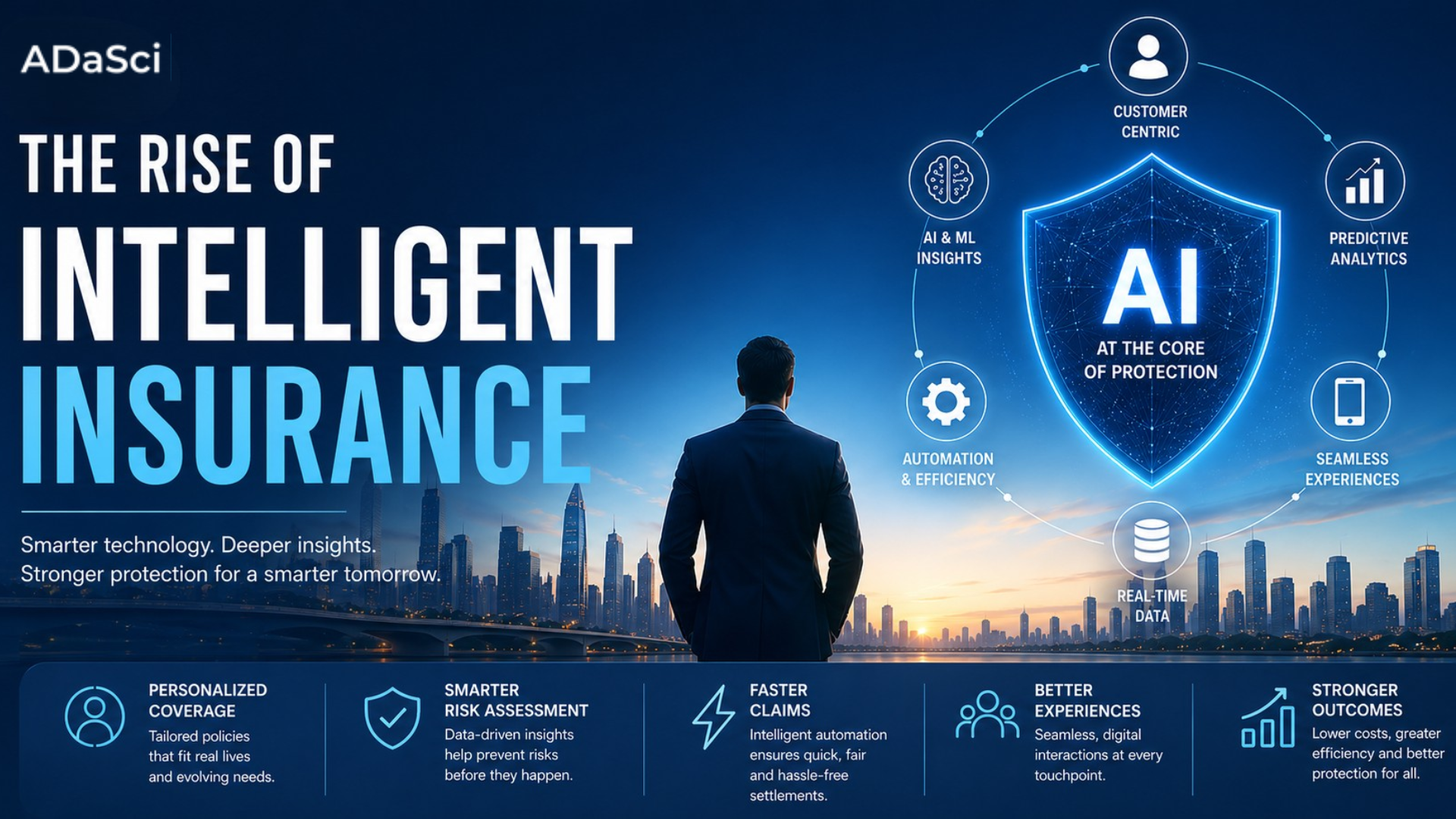
The Rise of Intelligent Insurance

For most of its history, insurance has been a fundamentally backward-looking industry. Actuaries studied the past, mortality tables, accident rates, and flood maps, and used that data to price the future. It was never perfect. It was, at best, a sophisticated guess. That era is ending. Artificial intelligence is not merely improving insurance’s existing processes. It is doing something more radical. It is replacing probability with prediction, swapping blunt demographic categories for granular behavioural signals, and shifting the entire industry from reactive to anticipatory.
Why did the Old Model break?
Traditional insurance rests on a simple but imperfect idea: pool similar risks together, and the law of large numbers will do the rest. A life insurer doesn’t know when you’ll die, but if they have ten million policyholders who are 45-year-old non-smoking men, they can price the pool with reasonable confidence.
The problem is that “similar” is doing enormous, contested work in that sentence. Insurance companies historically lumped people together based on broad proxies, age, gender, zip code, credit score, and prior claims, because those were the variables they could observe. The result was a system that often felt arbitrary from the inside.
The data landscape has changed with shocking speed. Smartphones track movement, sleep, and driving behavior. Smart home devices monitor water flow and appliance health. Connected cars stream real-time telemetry. Electronic health records aggregate decades of clinical history. Satellite imagery can now assess roof condition and proximity to vegetation from orbit. The question is no longer whether insurers have enough data, it is whether they can make sense of it, and whether they should.
The Four Pillars of AI-Powered Insurance
Across underwriting, pricing, claims, and distribution, AI is reshaping what each function looks like. The image below showcases the four areas where the transformation is most visible -

Underwriting Reimagined
Underwriting is the intellectual core of insurance, the judgment about whether to insure something, and at what price. For decades, it was performed by specialists reviewing paper applications, calling physicians, and consulting actuarial manuals. AI is not replacing that judgment, it is radically accelerating and refining it.
Modern insurtech companies like Lemonade, Root, and Tractable have pioneered models where applicants are assessed not against a demographic cohort but against a continuously updated behavioral fingerprint. Root Insurance, for example, prices auto coverage based on actual driving behaviour collected over a test period, hard braking, phone use, time of day, rather than on the applicant’s age and zip code alone.
In life and health insurance, AI models can now integrate genetic data, wearable health metrics, pharmaceutical claim histories, and mental health app usage to assess longevity and health trajectory with unprecedented granularity. The potential for savings, for both insurers and well-managed policyholders, is enormous.
The deeper transformation is what might be called the “segment of one”, the idea that every individual policyholder is their own actuarial class. Where pooled pricing creates cross-subsidies between the careful and the reckless, behavioral pricing promises to eliminate them. Whether that is a feature or a bug depends entirely on your values.
Claims
If underwriting is insurance’s brain, claims is its heart, the moment where abstract promises become real money. And for most of the industry’s history, it has been slow, adversarial, and frustrating for everyone involved.
The combination of computer vision, natural language processing, and fraud detection ML has made it possible to automate the entire claims journey for a large class of routine losses. Lemonade settled a stolen coat claim in under three seconds using its AI claims bot. More industrially significant are the deployments at traditional carriers: Zurich Insurance’s AI claims tool can assess vehicle damage from photographs, generate a repair estimate, and initiate payment, often before a human adjuster ever sees the case.

The fraud detection component deserves particular attention. Insurance fraud costs the global industry an estimated $80 billion annually. AI fraud models, trained on millions of prior claims and continuously updated, can identify behavioral anomalies, inconsistencies in submitted photographs, and network patterns suggesting organised fraud rings with a precision that human adjusters cannot match at scale.
The Prevention Pivot
Perhaps the most philosophically interesting shift in intelligent insurance is about not having claims at all. The economic logic is straightforward: for a carrier, a claim costs money. If AI can predict that a given policyholder’s pipes are likely to burst, based on building age, water usage anomalies, temperature forecasts, and corrosion data, and send a plumber before the burst happens, both parties benefit.
This logic is driving a profound shift in how insurance companies see themselves. Several of the largest carriers are repositioning not as risk transfer mechanisms but as risk management partners. AXA’s “Pay How You Live” program, Vitality’s health and life products, and John Hancock’s partnership with Apple Watch all reflect the same idea: embed AI deeply enough in the policyholder’s daily life, and you shift the product from reactive indemnity to proactive prevention.
For commercial property and infrastructure insurance, the opportunity for prevention is even greater. Industrial IoT sensors on bridges, pipelines, and manufacturing equipment generate continuous telemetry that AI systems can monitor for failure signatures, predicting conveyor belt breakdowns or structural fatigue weeks before they become catastrophic. Insurers partnering with asset owners on predictive maintenance are beginning to rewrite the fundamental value proposition of commercial coverage.
The Shadow Side - Ethics, Bias, and Exclusion
The promise of intelligent insurance is compelling. The peril is just as real. As AI becomes more deeply embedded in underwriting, pricing, and claims, a set of structural concerns is crystallising, as demonstrated by the image below -

Regulators are beginning to catch up. The EU’s AI Act imposes explainability requirements on high-risk AI systems, including financial services. Several US states have enacted restrictions on the use of credit scores and zip codes in auto pricing. The UK’s Financial Conduct Authority has flagged algorithmic pricing as a priority supervisory concern. But the pace of technological change is, for now, significantly ahead of the regulatory response.
Who Wins, Who Loses, and What Comes Next
The distribution of benefits from intelligent insurance is not neutral. Understanding who captures value and who bears new costs is essential to evaluating the transformation honestly.
Winners, so far, are the Low-risk individuals who are well-represented in training data, careful drivers, health-conscious individuals with wearables, and homeowners in low-risk areas, who can expect lower premiums meaningfully. BCG estimates that AI adoption could reduce insurance operating costs by 25–40% over the next decade.
Losers would be the individuals whose risk profile is elevated by factors beyond their control, or who lack the data literacy or technical infrastructure to benefit from behavioural programs. The chronically ill. Residents of climate-vulnerable communities. Workers in gig economy roles. Older individuals with thinner data footprints.
Conclusion
The rise of intelligent insurance is real, significant, and accelerating. The efficiency gains are genuine. The fraud reduction is meaningful. The prevention opportunity is potentially transformative. For the right policyholders, in the right segments, AI-powered insurance can be genuinely better, faster, more accurate, and more responsive.
But intelligence and wisdom are not the same thing. An AI system can be extraordinarily accurate at predicting individual risk and still produce a social outcome that most people, on reflection, would find unacceptable, a world where the riskiest lives are the most expensive to protect, and the safety net grows thinner precisely where it is most needed.
The conversation the industry has not yet had in earnest, but must, is about values, not algorithms. What is insurance for? Is it purely a financial instrument, or does it carry a social contract? Who decides which variables are legitimate to consider and which encode discrimination? And in a world of near-perfect risk prediction, who insures the uninsurable?
Sachin Tripathi
Sachin Tripathi is the Manager of AI Research at AIM, with over a decade of experience in AI and Machine Learning. An expert in generative AI and large language models (LLMs), Sachin excels in education, delivering effective training programs. His expertise also includes programming, big data analytics, and cybersecurity. Known for simplifying complex concepts, Sachin is a leading figure in AI education and professional development.
Get Credentialed
More Articles

Best FDE Course in 2026: CFDE vs Bootcamps vs Self-Study (Complete Comparison)
Aug 14, 2026
Your Resume Is Being Read by an Algorithm Before a Human—Here’s How to Engineer It
Aug 14, 2026
Why AIDP does not have a reading list
Jun 8, 2026
Your Team Can Demo AI. Can They Deploy It Inside a Customer’s Stack?
May 25, 2026