Your Resume Is Being Read by an Algorithm Before a Human—Here’s How to Engineer It

Your Resume Is Being Read by an Algorithm Before a Human—Here’s How to Engineer It
Let’s be honest for a second: the tech hiring market right now feels downright strange.
We are witnessing a wild paradox. On one side, OpenAI releases GPT-5.6, Anthropic rolls out Claude Architect credentials, and big tech scale-ups are competing for top-tier talent. Companies are desperate for people who actually know how to deploy AI, not just talk about it.
On the other side, brilliant senior engineers—folks with 10 to 12 years of hands-on experience in Spark, cloud migrations, and production RAG pipelines—are dropping 200 applications on LinkedIn and getting automated rejection emails within four minutes.
So, what is happening? Did your decade of hard work suddenly become irrelevant?
Not at all. The problem isn't your experience—it’s how your experience is encoded.
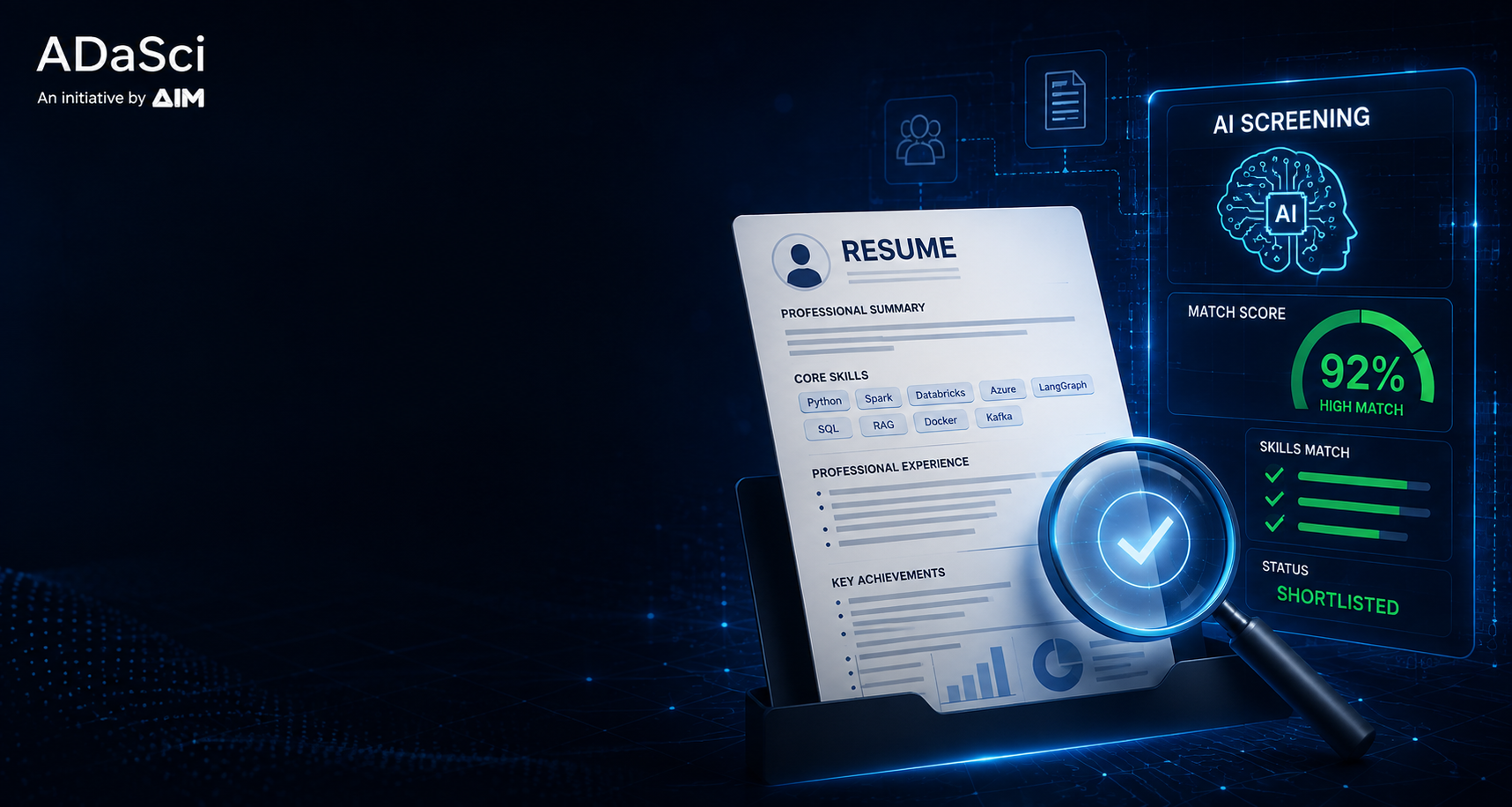
Before a recruiter at Google, Databricks, or Palantir ever opens your PDF, an Applicant Tracking System (ATS) or an AI screening agent parses it. It dissects your career, normalizes your job titles, checks your skills against an internal taxonomy, and assigns you a match score.
If your resume reads like a traditional piece of prose, the algorithm gets confused, downranks your profile, and routes you straight to the "unsuccessful" pile.
To land top-tier roles today, you have to stop treating your resume like an essay. You need to treat it like a structured data architecture.
The 80% Filtering Paradox: Why Strong Engineers Get Rejected
In traditional enterprise tech teams, roles used to be strictly siloed:
- Data Scientists built models in Jupyter Notebooks.
- Software Engineers wrote basic API wrappers.
- Cloud Architects set up AWS or Azure buckets.
Today, enterprise AI projects are stalling. Over 80% of enterprise AI prototypes die before reaching production because no one owns the end-to-end execution.
Enterprises don't want isolated coders anymore. They want Forward-Deployed AI Engineers (FDEs)—professionals who can walk into a client's office, understand complex business workflows, design secure multi-agent architectures (using tools like LangGraph or AutoGen), and deploy them into live production environments.
Because these roles are high-leverage (often paying top-of-market compensation packages), companies use aggressive AI screening tools like Lever, Greenhouse, and Workday to filter out noise.
When you click "Apply," the ATS converts your resume into machine-readable JSON signals:
{
  "role_identity": "Unclear / Generic",
  "skill_taxonomy_match": 0.42,
  "evidence_strength": "Low (No metrics attached)",
  "verdict": "Auto-Reject"
}
If the machine can't verify your claims with hard technical evidence and outcomes, a human recruiter will never even know you applied.
A Real Case Study: The "Arjun Mehta" Transformation
To see what this looks like in practice, let's look at a typical candidate profile: Arjun Mehta.
Arjun has 12 years of solid experience in the BFSI (Banking & Financial Services) sector. He knows Python, SQL, Spark, Azure Data Factory, Databricks, and Kafka inside out. He even built an enterprise RAG assistant using vector databases.
Yet, his original resume was getting zero callbacks. Why?
Layer 1: Positioning & Header Architecture
The Mistake: Arjun’s header read:
Arjun Mehta | Technology Professional
The Fix: "Technology Professional" is a ghost title. It gives the algorithm zero signal. We restructured his header to give instant clarity:
Arjun Mehta
Senior Data & AI Engineer | Databricks | Azure ADF | Spark | Enterprise Data Platforms
12 years modernizing enterprise data platforms across BFSI environments.
The Takeaway: Tell the machine (and the recruiter) exactly what you are in the first 3 seconds. Do not make them guess on page two.
Layer 2: Keyword Lists vs. Verified Evidence
Most candidates create a bulleted list at the top of their resume that looks like this:
Skills: Python, Spark, Databricks, Azure, Kafka, GenAI, RAG, Architecture
Why this fails: Algorithms know people copy-paste keywords straight from the Job Description. Modern ATS parsers look for evidence density—they want to see how and where you used those tools.
The Fix: Instead of floating keywords, we tie tools directly to architectural achievements:
- Weak Keyword: Kafka, Databricks
- Evidence-Rich Blueprint: Built a Databricks/Spark ingestion framework processing 40+ enterprise data feeds, integrating batch and real-time streaming pipelines via Lakeflow on Lakehouse.
Layer 3: The Golden Formula for Bullet Points
If your resume is filled with sentences that start with "Responsible for..." or "Worked on...", you are losing interviews. Responsibilities describe your job description; outcomes prove your value.
To make every line machine-readable and interview-defensible, use this formula:
Action Verb + Scale / Scope + Specific Tech Stack + Quantifiable Outcome
Let's look at how Arjun’s bullet points were rewritten:
- ❌ Before: Responsible for migration of data pipelines to cloud.
- ✅ After: Led migration of 80+ batch pipelines to Azure/Databricks, consolidating legacy ETL patterns and reducing support incidents by 30%.
- ❌ Before: Worked on GenAI proof of concept.
- ✅ After: Designed a RAG-based knowledge assistant using enterprise documents, vector retrieval, and source citations, reducing analyst search effort across three business units.
The 8-Point Resume Architecture Test
Before you send out your next job application, run your resume through this 8-point checklist:
- Identity Signal: Is your target role clear within 5 seconds of looking at the top fold?
- Parsable Structure: Are you using standard section headings (
Work Experience,Skills,Education) that an ATS can read without garbling the text? - Requirement Mapping: Have you naturally reflected the core capabilities mentioned in the target job description?
- Evidence Density: Is every major technical skill backed up by a concrete project or deliverable?
- Outcome Metricization: Did you include hard numbers (percentages saved, pipeline latency reduced, dollar values, team size)?
- Taxonomy Accuracy: Are you using precise platform names (e.g., Azure Data Factory, Unity Catalog, LangGraph) rather than generic terms?
- Interview Defensibility: Is every claim 100% truthful and ready to be defended in a deep-dive technical interview?
- Recruiter Readability: Can a human recruiter scan your document in 30 seconds and instantly understand your value proposition?
Closing the Gap: From Resume to Real-World Execution
Optimizing your resume structure is half the battle—it gets your foot in the door. But when you step into the interview room with an Enterprise Architect or VP of Engineering, you need the technical authority to back it up.
That is why top-tier practitioners don't just stop at resume formatting. They validate their end-to-end execution capabilities through industry-standard credentials like the Certified Forward-Deployed Engineer (CFDE) or AI Delivery Professional (AIDP) conferred by ADaSci (Association of Data Scientists).
Having verified, institutional proof that you can bridge the gap between complex AI prototypes and secure enterprise production makes your resume mathematically impossible for both algorithms and recruiters to ignore.
🇮🇳 Celebrate Independence Day with ADaSci!
To mark India’s 80th Independence Day and support our global community of tech leaders, ADaSci is offering a Flat 25% OFF on all flagship certifications (CFDE & others).
Use promo code INDIA80 at checkout to claim your grant and take complete ownership of your career trajectory in the AI economy.
Anirban Ghatak
Anirban Ghatak is a seasoned AI & Data Science leader with over 21 years of experience building, scaling, and leading analytics, BI, and data science business units with full P&L ownership and C-level reporting. An alumnus of BITS Pilani and IIM Indore, Anirban is an ex-founder and intrapreneur specialized in taking enterprise AI practices to scale. He is a prominent industry voice and speaker on the evolution of work in an Agentic AI world, advocating for the transition from systems of execution to hybrid systems of autonomous orchestration and robust AI governance.
Get Credentialed
More Articles

Best FDE Course in 2026: CFDE vs Bootcamps vs Self-Study (Complete Comparison)
Aug 14, 2026
Why AIDP does not have a reading list
Jun 8, 2026
Your Team Can Demo AI. Can They Deploy It Inside a Customer’s Stack?
May 25, 2026
The Rise of Intelligent Insurance
Apr 29, 2026